

P4L webinar explores leadership's 'dark side'
Updated: Jul 23

The ‘dark side’ of leadership was in the spotlight at Partners for Leadership’s recent interactive webinar with experts from two top-tier UK business schools.
The 60-minute discussion was the first in a series of webinars to be hosted by Partners for Leadership with the support of the Telos Partners team.
It focused on how, in a world where leadership failures are increasingly visible, too often we rush to blame individuals for corporate failure – without considering the wider context and role that others might have played.
By exploring the systemic causes of destructive leadership, attendees gained practical insights to help strengthen their understanding and response to the complexities of leading at the highest levels today.
Using participant input and case studies to highlight the traits, behaviours and systemic factors that drive destructive leadership, Richard Bolden (Professor of Leadership and Management and Director of the UWE Bristol Leadership and Change Centre) led the discussion – alongside Dr Peter Stephenson (Lecturer in Leadership and Management) and Morgen Witzel (author and lecturer on leadership, ethics and governance) from the University of Exeter Business School.
Expert-led discussion relevant to leaders today
'The discussion emphasised that dark leadership is not solely the result of individual failings but is shaped by systemic, cultural and regulatory factors'
Richard Bolden began with a series of interactive polls which revealed that most attendees had direct or indirect experience of dark leadership.
Terms used included 'toxic', 'bullying', 'manipulative' and 'abuses of power', illustrating the various ways in which dark leadership can be perceived.
Peter Stephenson then presented two high-profile case studies – Theranos and Purdue Pharma – to show what dark leadership looks like in the real world.
The Theranos case focused on founder Elizabeth Holmes and the pressures and cultural norms that contributed to unethical behaviour, while the Purdue Pharma case examined regulatory failures and the broader opioid crisis, highlighting how responsibility extends beyond individual leaders.
The discussion emphasised that dark leadership is not solely the result of individual failings but is shaped by systemic, cultural and regulatory factors.
Examples cited included the role of media, advisory boards and legal frameworks in enabling or excusing unethical actions, as well as the influence of stakeholder egos and collective behaviours.
Introducing the Dark Pyramid framework
Making the case for a more nuanced assessment of leadership, the speakers challenged the dichotomy of 'good' versus 'bad' leaders.
They noted that celebrated leaders often exhibit traits associated with the ‘dark side’, such as narcissism or dishonesty.
The discussion also looked at how outcomes and societal perspectives influence ethical assessments – and questioned whether leadership should be judged by results or by process.
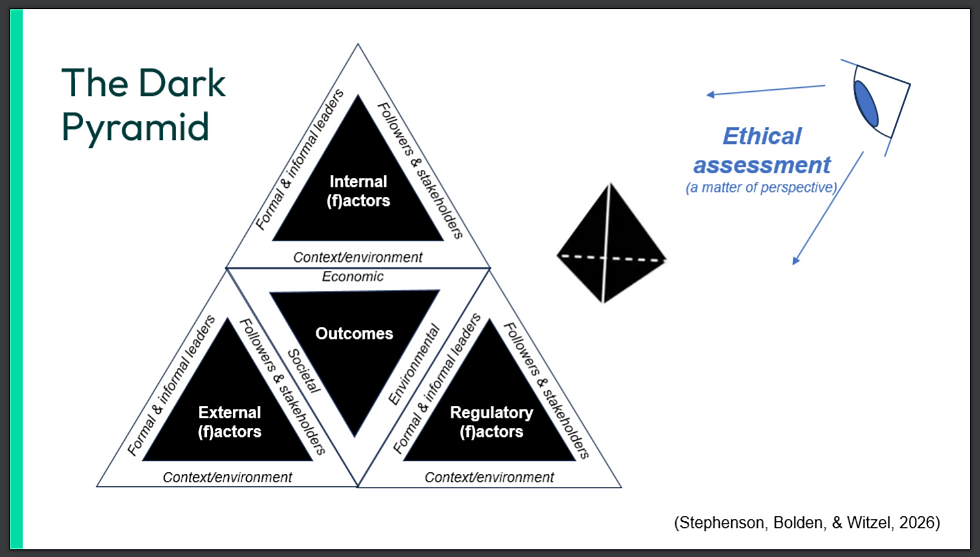
Building on this theme, Richard Bolden went on to introduce the ‘Dark Pyramid’ framework, which he developed with Professor Stephenson and Morgen Witzel to provide a holistic approach to analysing destructive leadership.
The team discussed its structure, application and relevance across both the private and public sectors.
Richard Bolden then explained how the Dark Pyramid:
· builds on Padilla's 'Toxic Triangle', expanding the focus from individual leaders to include followers, stakeholders and contextual factors
· incorporates both internal and external actors, formal and informal leaders, and environmental and regulatory contexts
· encourages leaders to ‘zoom out’ from individual blame and consider the interplay of multiple contributors to destructive leadership
· highlights the importance of outcomes – economic, societal and environmental – and recognises the subjectivity inherent in ethical assessments.
How the Dark Pyramid framework can help leaders
'The Dark Pyramid framework can be used to evaluate the causes of destructive leadership, audit organisational risks and assess individual and collective positions within systems of influence'
So how can the Dark Pyramid framework be applied in practice?
In several ways:
The Dark Pyramid framework can be used to evaluate the causes of destructive leadership, audit organisational risks and assess individual and collective positions within systems of influence.
Stakeholders are encouraged to challenge unethical practices, recognise their own complicity and actively dismantle dysfunctional systems.
Looking at governance and stewardship, Morgen Witzel and others discussed the critical role both play in preventing leadership failures, emphasising that business failures often stem from governance breakdowns.
The Dark Pyramid framework supports systemic scrutiny and collective responsibility, rather than focusing solely on high-profile individuals.
Question time – what the audience wanted to know
'Systemic failures often contribute to poor leadership behaviour but leaders can be supported'
The webinar’s attendees had a number of questions for the speaker panel on topics ranging from the ‘banality’ of evil and the role social media plays to limitations in evaluating organisations and support for leaders displaying ‘dark’ traits.
The team linked their responses to how the Dark Pyramid framework could be practically applied.
Here is a round-up of the key points they made:
Banality of evil and ethical complexity: while ‘evil’ may be present in cases of malpractice, it’s important to distinguish between inherent individual traits and circumstantial factors – advocate for a focused and nuanced ethical analysis.
Role of media and social influence: social media and broadcasting have helped to amplify ‘dark’ leadership – examples include financial crises and the way in which media can create a ‘herd’ instinct and influence stakeholder behaviour, often without sufficient scrutiny.
Evaluating invisible and intangible factors: the challenges organisations face because of these emphasises the need for a systemic and collective approach, as supported by the Dark Pyramid framework.
Supporting leaders facing ‘Dark Pyramid’ pressures: systemic failures often contribute to poor leadership behaviour but leaders can be supported – the Dark Pyramid framework has been designed to help identify processes and pressures and encourage both organisational and individual support.
The Dark Pyramid webinar – next steps for senior leaders

See what you missed – watch 'The Dark Side of Leadership' webinar here.
Explore the originating British Journal of Management paper on the Dark Pyramid authored by Peter Stephenson, Richard Bolton and Morgen Witzel here.
Want to know more about Partners for Leadership?

Partners for Leadership is a two-year strategic leadership development experience created specifically for senior strategic leaders and those on the path to the top – delivered in association with Telos Partners.
The peer-led experience helps organisations prepare their next generation for the challenges they will face – and ensure they lead the field once in role.
Find out more here and get in touch to discuss joining the next cohorts on 23-24 February, 8-9 June and 21-22 September 2027.


